How BURST, with the expert support of the Metropolitan Research Institute (MRI), is building the evidence architecture of the Energy2Act project in Cesena — and why the discipline of measurement has quietly become one of the most consequential roles in EU-funded work?
By Zsófia Bulla, Consultant at BURST
There is a quiet but decisive shift underway in how the European Union pays for the projects it funds. For much of the last two programming periods, the key question of reporting was procedural: were the costs eligible, and were they incurred correctly? The question the Union is increasingly asking instead is a harder one: what change has the money actually resulted in? For anyone working in programme management, that is not a rhetorical nuance. It re-orders where risk sits, where effort must go, and which function inside a consortium carries the weight.
From reimbursing costs to rewarding results
The direction of travel is unambiguous. In the 2021-2027 programming period the Recovery and Resilience Facility introduced, at scale, a financing logic in which disbursement is tied not to invoices, but to the verified achievement of milestones and targets. Payment requests are assessed against whether pre-agreed, measurable steps have genuinely been delivered. Where they have not, funds are withheld or reduced.1 In parallel, Cohesion Policy instruments have expanded the use of Simplified Cost Options (SCOs) and, more radically, Financing Not Linked to Costs (FNLTC), under which reimbursement is triggered by the fulfilment of conditions and results, rather than by the substantiation of expenditure.2
The Commission’s proposal for the 2028–2034 Multiannual Financial Framework signals that this is the template for the future, not a one-off crisis instrument. Under the proposed National and Regional Partnership Plans, the RRF’s performance logic would be extended across the bulk of cohesion and agricultural spending, with financing decisions setting out the milestones, targets and associated payment values against which delivery is judged.3 Independent commentary — including from the European Court of Auditors — has rightly flagged the unresolved tensions: the risk of conflating outputs with genuine results, the absence of a harmonised methodology for setting sufficiently ambitious targets, and the governance question of who verifies achievement.4 But the underlying principle is now firmly established: public money follows demonstrated performance.
It is worth being precise, because precision is the point. Not every instrument has completed this transition yet. The European Urban Initiative (EUI), which amongst many other Innovative Actions finances the Energy2Act project, still operates on the total-costs principle, with ERDF covering up to 80% of eligible costs and payments validated through First Level Control.5 Yet even here the gravitational pull of the result-based paradigm is unmistakable: output and result indicators have to be constructed in line with the Commission’s RACER criteria, ensuring that each indicator is Relevant to the objective, Accepted by those it concerns, Credible and readily interpretable, Easy to monitor at reasonable cost, and Robust against manipulation6. These indicators, together with target values fixed at application stage, annual progress reporting, formal milestone reviews and the corresponding ongoing result-based monitoring activities are the currency in which a project’s credibility — and its case for continued and future funding — is now denominated. The strategic message for consortia is therefore the same across the spectrum: an inability to evidence results is no longer merely an administrative shortcoming. It is a financial and reputational liability.
Why this raises the stakes for monitoring
When funding was reimbursed against costs, monitoring and evaluation (M&E) could be treated — and too often was — as a downstream reporting duty appended to ‘real’ delivery. In a result-based environment that hierarchy inverts. If money follows proof, then the systems that generate, verify and interpret the proof become load-bearing. A robust indicator framework, a defensible baseline and a disciplined data pipeline are no longer good practice; they are the mechanism through which the project remains solvent and demonstrably impactful. This is the conviction with which BURST leads Work Package 3, the monitoring and evaluation work package of Energy2Act, supported by the analytical expertise of the Metropolitan Research Institute.
Energy2Act: measuring a transition that is as social as it is technical
Energy2Act (2025–2029) sets out to accelerate the energy transition in the Italian municipality of Cesena, with climate neutrality by 2050 as its horizon.7 Its distinctive premise is that decarbonisation is not, at root, an engineering problem to be solved for a passive population, but a process of collective activation: moving residents of the Vigne pilot district from bystanders to co-owners of Positive Clean Energy Neighbourhoods (PCEN). The project mobilises a One-Stop-Shop for Climate Communities, a multilayer Decision Support System and a Climate Community Exchange System to that end. From a monitoring perspective, this dual character — hard infrastructure and soft behaviour — is precisely what makes the assignment demanding.
Three problems that make this genuinely hard
- The baseline-from-zero problem. A result-based framework is only as credible as the counterfactual it is measured against — and in Cesena, that counterfactual had to be built from very little. Granular, building-level energy performance data and localised socio-economic vulnerability data were largely absent, meaning that a substantial share of result indicators effectively started from a baseline of zero. Without a defensible ex-ante reference, no future claim of impact can survive scrutiny.
- The quadruple-helix data problem. Energy2Act runs across a heterogeneous consortium — municipal authorities, research institutions, SMEs and civic cooperatives — each with its own instruments, cadences and definitions. Producing indicator data that is consistent, comparable and audit-ready across such varied partners is a problem of procedural alignment as much as of measurement, and it does not solve itself.
- The intangibles problem. Thermal performance and renewable output are straightforward to meter. Community activation is not — yet it is the variable on which the entire theory of change depends. Measuring it without reducing it to a hollow ‘engaged / not engaged’ tick-box is the methodological crux of the project.
Our answer to the third problem is the Community Readiness Level (CRL) model, adapted from the readiness frameworks of Colorado State University8 and combined with a technology-oriented Societal Embeddedness Level. Rather than a binary judgement, the CRL scores a community along a nine-stage continuum — from ‘no awareness’ to ‘community ownership’ — across six dimensions, including local leadership, community climate, and knowledge of the issue. Baselining proceeds through the mapping of six to ten local ‘gatekeepers’, structured interviews, and independent scoring by two community-building experts to reach a consensus value. Crucially, the resulting score is diagnostic, not merely descriptive: it calibrates the tailored engagement that Community Catalysers then deploy to move the neighbourhood to the next stage. Social change, in other words, is rendered measurable without being flattened.
What we have built so far
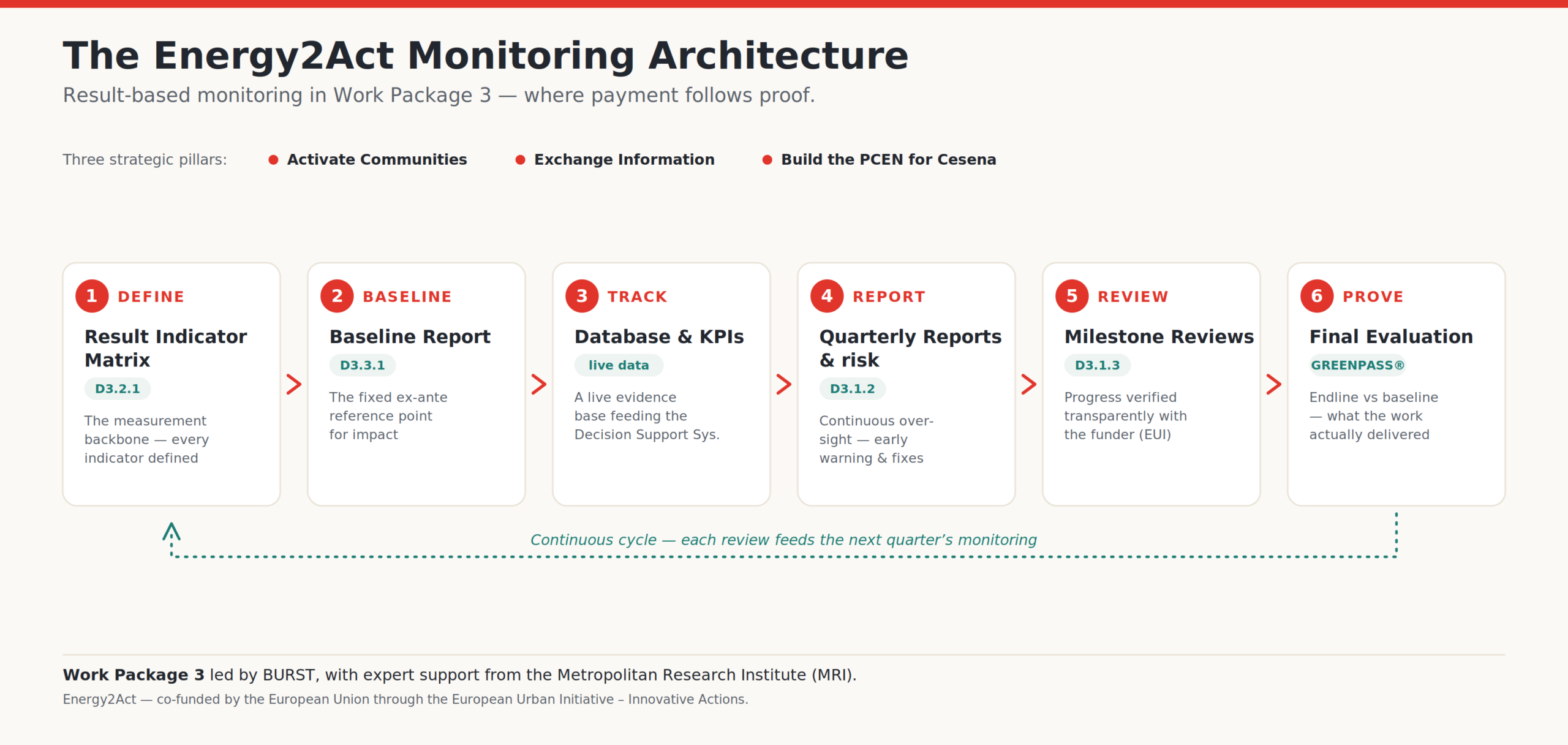
Under WP3, the abstract commitment to result-based rigour has been converted into concrete, delivered instruments. Four are already in place.
- The Result Indicator Matrix (D3.2.1) is the project’s measurement backbone. Developed jointly with all partners and structured around the project’s three strategic pillars — Activate Communities, Exchange Information and Build the PCEN for Cesena — it defines each technical, social and financial indicator, its logic and its link to the interventions it is meant to evidence. It is the document that makes every subsequent claim of progress traceable.
- The Baseline Report (D3.3.1) confronts the baseline-from-zero problem directly, establishing ex-ante reference values across energy, environmental and social indicators, setting out the methodology behind them, and — tellingly for an expert reader — including a candid critical analysis of the key challenges, risks and data gaps that remain. It is the fixed point against which impact will ultimately be proven.
- The first Quarterly Report and risk-mitigation cycle (D3.1.2) operationalises continuous oversight: tracking outputs and KPIs against targets, recording milestones reached, and surfacing challenges and corrective recommendations early enough to act on them. In a result-based world, an early-warning system is not bureaucracy — it is risk management with money attached.
- The first Milestone Review (D3.1.3) closes the loop with the funder, reporting progress against strategic milestones transparently to the EUI Secretariat. Together with the standing monitoring working group and the forthcoming Monitoring and Evaluation Framework, these deliverables form a coherent apparatus rather than a stack of documents.
The road to 2029
The work now shifts from designing the architecture to running it. The priorities are the operation of the Energy2Act database — consolidating sensor telemetry and survey data into a living evidence base that feeds the Decision Support System and flags deviations as they emerge; the continued quarterly risk reporting and six-monthly milestone reviews; and the tracking of a Global Vulnerability Index, whose measured decline is intended to give quantitative substance to the project’s claim of alleviating energy poverty. The culmination will be the Final Evaluation Report, contrasting endline against baseline to assess what the intervention actually delivered — and to underpin the neighbourhood’s GREENPASS® certification at closure.
The broader point is one worth holding onto as the EU’s financing model evolves. As payment follows proof, the capacity to track, verify and honestly interpret both the hard data of energy infrastructure and the soft data of human behaviour ceases to be a support function and becomes a strategic one. In Energy2Act, that is the role BURST and MRI have taken on: not to describe the transition after the fact, but to make it demonstrable while it happens.Energy2Act is co-funded by the European Union through the European Urban Initiative – Innovative Actions.
References
1. Regulation (EU) 2021/241 of the European Parliament and of the Council of 12 February 2021 establishing the Recovery and Resilience Facility (OJ L 57, 18.2.2021) — in particular Article 24 (payments conditional on the satisfactory fulfilment of milestones and targets). https://eur-lex.europa.eu/eli/reg/2021/241/oj/eng
2. Regulation (EU) 2021/1060 of the European Parliament and of the Council of 24 June 2021 laying down common provisions (Common Provisions Regulation, OJ L 231, 30.6.2021) — Articles 53–56 (simplified cost options) and Article 95 (financing not linked to costs). https://eur-lex.europa.eu/eli/reg/2021/1060/oj/eng
3. European Commission, ‘The EU budget for 2028–2034’ — proposal for the next Multiannual Financial Framework and the National and Regional Partnership Plans; see also the Proposal for a Regulation on the ERDF, Interreg and the Cohesion Fund within the Plans, COM(2025) 552 final. https://commission.europa.eu/strategy-and-policy/eu-budget/long-term-eu-budget/eu-budget-2028-2034_en · https://eur-lex.europa.eu/legal-content/EN/TXT/?uri=celex:52025PC0552
4. European Court of Auditors, Special Report 21/2022: ‘The Commission’s assessment of national recovery and resilience plans’. https://op.europa.eu/webpub/eca/special-reports/nrrp-21-2022/en/
5. European Urban Initiative, ‘EUI – Innovative Actions Guidance’ — total-costs principle, ERDF co-financing of up to 80% of eligible costs, and validation of expenditure through First Level Control. https://www.urban-initiative.eu/sites/default/files/2024-05/EUI-IA%20GUIDANCE_24IV2024.pdf
6. European Commission, Better Regulation Toolbox, Tool #43 ‘Monitoring arrangements and indicators’ (RACER criteria for indicator quality). https://commission.europa.eu/law/law-making-process/better-regulation/better-regulation-guidelines-and-toolbox/better-regulation-toolbox_en
7. European Urban Initiative, project record: ‘Collaborative ENERGY to ACTivate communities towards climate neutrality (Energy2Act)’, City of Cesena, 3rd Innovative Actions Call. https://www.urban-initiative.eu/ia-cities/cesena/about-projects
8. B. A. Plested, R. W. Edwards & P. Jumper-Thurman, ‘Community Readiness for Community Change’ (Community Readiness Model), Tri-Ethnic Center for Prevention Research, Colorado State University. https://tec.colostate.edu/wp-content/uploads/2018/04/CR_Handbook_8-3-15.pdf
Author’s note. This article was written by Zsófia Bulla, Consultant at BURST, based on an original idea by Mónika Németh, Managing Director of BURST. AI tools were used as part of the process: the article’s original structure drew on input from Google’s Gemini, while the research, drafting, restructuring, sourcing and fact-checking were carried out with the help of Anthropic’s Claude (in Cowork). All arguments, professional judgements, verification of the sources cited and the final wording are the author’s own — the AI served as a drafting and research aid under human direction and review throughout.